All the Devils Are Here
American Romanticism and Literary Influence
David Greven
subjects:
The English literary influence on classic American novelists’ depictions of gender, sexuality, and race
With All the Devils Are Here, the literary scholar David Greven makes a signal contribution to the growing list of studies dedicated to tracing threads of literary influence. Herman Melville’s, Nathaniel Hawthorne’s, and James Fenimore Cooper’s uses of Shakespeare and Milton, he finds, reflect not just an intertextual relationship between American Romanticism and the English tradition but also an ongoing engagement with gender and sexual politics.
Greven limns the effect of Shakespeare’s Much Ado about Nothing on Hawthorne’s exploration of patriarchy, and he shows how misogyny in King Lear informed Melville’s evocation of “the step-mother world” of orphaned men in Moby-Dick. Throughout, Greven focuses particularly on male authors’ treatment of femininity, arguing that the figure of woman functions for them as a multivalent signifier for artistic expression. Ultimately, Greven demonstrates the ambitions of these writers to comment on the history of the Western tradition and the future of art from their unique positions as Americans.
- American Literary HistoryGreven’s book succeeds in demonstrating the richness of intertextual exchange in American Romanticism and its potential to reshape our understanding of influence. His attention to aesthetics gives the project its stakes, and his chapters’ careful, often counterintuitive readings justify his interest in revisiting such familiar figures and texts. All the Devils Are Here is a valuable contribution to both American and transatlantic literary studies, and a useful model for revisiting canonical literature to address new questions. In boldly inviting so many “devils” of British literature, US literature and influence studies back into the critical conversation, Greven invites us to reconsider the possibilities of influence and intertextuality, not as evidence of a static hierarchy, but rather as living sites of aesthetic and political exchange.
With his open-hearted engagement with texts, Greven offers new styles of connection and navigates critical questions deftly and in ways that illuminate the work with tremendous lucidity and élan. The writing is splendid.- Wyn Kelley, MIT School of Humanities, Arts, and Social Sciences, author of Melville’s City: Literary and Urban Form in Nineteenth-Century New York
An engaging, theoretically sophisticated book. . . Ultimately, this monograph should appeal to scholars of intertextuality, transatlantic studies, queer and gender studies, nineteenth-century American literary studies, and especially the works of Hawthorne and Melville. It is a book whose individual textual readings well reward the time spent with them.- Nineteenth-Century Contexts
Tracing lines of influence in texts while at the same time broadening perspectives on those texts, as Greven’s book demonstrates, bears important fruit. This study, then, achieves what it advocates and renews the value of an approach for our times.- Revue française d'études américaines
A solid literary study, bringing with it not only considerations of justice and Shakespeare’s inspiring, terrifying (and English) precedent but, as interpreted by Frederick Douglass, racial concerns. . . Although Greven (Univ. South Carolina) evokes the influence theories of Harold Bloom, his focus is less on the agony of wrestling with predecessors than how one engagement with a predecessor text opens up others . . . A productive rereading of crucial American texts. Recommended.- CHOICE
What David Greven’s book firmly establishes in a spirit not of agonistic rivalry but of open-hearted embrace of other scholars is that critical reading of a text, just as well, may mother us all.- American Book Review
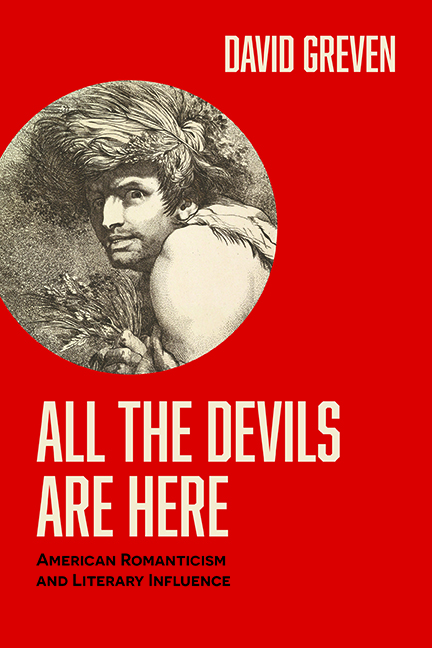
[A] superb study . . . All the Devils Are Here accomplishes many things at once. On its face—and how interesting to feature the “face” of King Lear’s wild Edgar on the cover of the book! (and I should add that there are lovely illustrations throughout)—Greven’s study offers fascinating readings of major novels by Cooper, Hawthorne, and Melville, which makes it valuable to anyone interested in these authors or American Romanticism more broadly. It is a major contribution to the theory of influence, and thus an important work of literary theory and methodology in its own right. It also models a creatively psychoanalytical approach to literature that is irreducible to any school of Freudian thought, while also demonstrating the possibilities of a nuanced, flexible, and innovative way of reading such concepts as incest, narcissism, and melancholia. Partly for this reason, All the Devils Are Here is also a valuable addition to the field of gender and sexuality studies, not to mention studies of race and religion, and to cultural studies writ large. At the risk of ending this review with a pun, I expect that Greven’s study will itself be quite influential, rightly so.- Leviathan
Greven’s range of reference is always impressive, and his bibliography is both extensive and apt, covering classic readings of the last century alongside more unusual interventions. Also, Greven’s focus on contemporary concerns, especially those of race, sexuality and queerness, enables him to offer genuinely new insights into well-known texts, shifting the dynamic of influence studies away from a linear historical approach towards more subtle thematic resonances. Indeed, Greven’s non-agonistic reconceptualization of influence as a collaborative and creative dialogue is a valuable addition to critical scholarship.- Transatlantica
- Nathaniel Hawthorne ReviewReflects thoughtfully and comments incisively upon the diverse ways in which race and gender intersect in the Anglo-American literary tradition, opens further vistas for future interrogation, and functions as a case in point of its primary thesis that studies of literary influence remain of critical relevance today.
David Greven is Professor of English at the University of South Carolina and the author of The Fragility of Manhood: Hawthorne, Freud, and the Politics of Gender.

