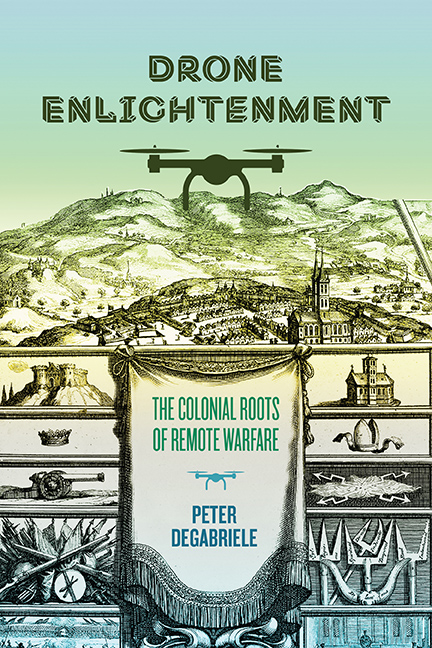
Drone Enlightenment
The Colonial Roots of Remote Warfare
Peter DeGabriele
Drone warfare raises far-reaching questions about responsibility, war, and sovereignty. Who can be held accountable for drone strikes? Do drones conduct wars of national territories and sovereign boundaries? What does the occupation of a land or people look like if there are no boots on the ground? Focusing specifically on the United States' use of killer drones during the War on Terror, Drone Enlightenment argues that this kind of warfare has its intellectual, ideological, and practical roots in the way the Enlightenment imagined moral agency, occupation, race, and sovereignty. As a consequence of seeing drone warfare as a creature of the Enlightenment, and through innovative readings of Hobbes, Locke, Grotius, Pufendorf, Barbeyrac, and Swift, the book also reevaluates the Enlightenment itself.
- Tony C. Brown, University of Minnesota, author of The Primitive, the Aesthetic, and the Savage: An Enlightenment ProblematicDeGabriele makes original use of the drone and contemporary drone warfare to open up new readings of the early Enlightenment natural right tradition, as well as using that tradition to reread the drone to examine its relation to questions of sovereignty, occupation and the right to kill. The book straddles Enlightenment philosophy, British literature, warfare, and colonialism past and present, breathing fresh life into an often asthmatic area of scholarship
Through rich readings of major Enlightenment tracts on sovereignty, colonization, and human geography, DeGabriele argues that the drone strikes conducted by the Obama administration were in fact perfectly consistent with an Enlightenment that was always invested in maintaining and extending sovereign power. Moreover, he frames the asymmetrical violence imparted by US drone strikes not as the antithesis to the liberal and democratic ideals fashioned in early modern Europe, but as a necessary and constitutive feature of Enlightenment thought. In so doing, Drone Enlightenment successfully navigates one of the oft-discussed paradoxes of the Enlightenment era, a period that fostered liberatory social and political formations on the one hand and cultivated unprecedented forms of expropriation and human domination on the other, particularly in the context of colonial capitalism.- Eighteenth-Century Studies
Peter DeGabriele is Associate Professor of English at Mississippi State University and the author of Sovereign Power and the Enlightenment: Eighteenth-Century Literature and the Problem of the Political.
1. Sovereign (Ir)responsibility
2. Remote Occupation
3. Deferred Extermination
Introduction: Drone Warfare, Enlightenment, and Asymmetry
Epilogue: Publicity and Mediation
Bibliography
2. Remote Occupation
3. Deferred Extermination
Introduction: Drone Warfare, Enlightenment, and Asymmetry
Epilogue: Publicity and Mediation
Bibliography

