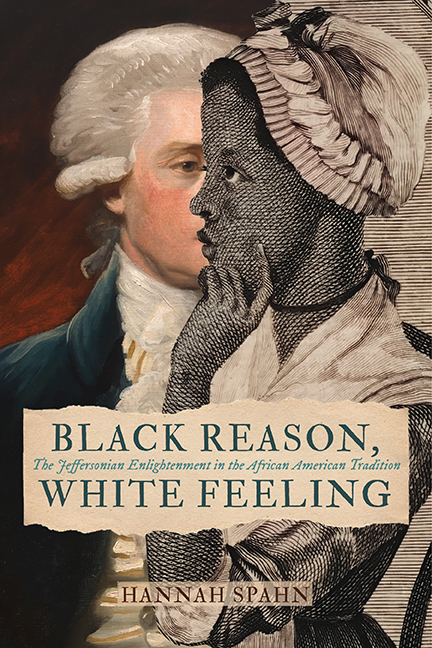
Black Reason, White Feeling
The Jeffersonian Enlightenment in the African American Tradition
Hannah Spahn
Series:
awards:
Kenshur Book Prize, (2025, Finalist)
The vital influence of Black American intellectuals on the legacy of Thomas Jefferson’s ideas
The lofty Enlightenment principles articulated by Thomas Jefferson in the Declaration of Independence, so central to conceptions of the American founding, did not emerge fully formed as a coherent set of ideas in the eighteenth century. As Hannah Spahn argues in this important book, no group had a more profound influence on their development and reception than Black intellectuals. The rationalism and universalism most associated with Jefferson today, she shows, actually sprang from critical engagements with his thought by writers such as David Walker, Lemuel Haynes, Frederick Douglass, and W. E. B. Du Bois.
Black Reason, White Feeling illuminates the philosophical innovations that these and other Black intellectuals made to build on Jefferson’s thought, shaping both Jefferson’s historical image and the exalted legacy of his ideas in American culture. It is not just the first book-length history of Jefferson’s philosophy in Black thought; it is also the first history of the American Enlightenment that centers the originality and decisive impact of the Black tradition.
A substantial contribution to the scholarship on Jefferson, the early American republic, and African American intellectual and literary history.- Annette Gordon-Reed, Harvard University, Pulitzer Prize–winning author of The Hemingses of Monticello: An American Family
Few have mined the connections and overlapping concerns between the Black and white intellectual worlds as well as Spahn. Her text gives us that truly wide canvass of dual Enlightenment cultures that we so desperately need.- Richard S. Newman, Rochester Institute of Technology, author of Freedom’s Prophet: Bishop Richard Allen, the AME Church, and the Black Founding Fathers
A meticulously researched, carefully argued book. It makes a complex American intellectual tradition accessible to non-specialists . . . Superb . . . Spahn’s work offers an opportunity to bridge the intellectual divide between those scholars who emphasize the United States’ foundation on ideas of liberty and those who see the nation’s founding amidst the cruel oppression of racism and slavery. In end this work gives scholars much to ponder in the telling of how these two ideological strands of the American Enlightenment are intertwined and how Black intellectuals resisted oppressive frameworks of knowledge by focusing on the principles of universal freedom. These examples offer us hope through their examples of how critical conversations can help answer difficult challenges in our own time.- Journal of the Early Republic
- American Historical ReviewSpahn has created a necessary new contribution to an evolving historiography of the Black intellectual tradition.
Hannah Spahn is Professor of American Studies at the John F. Kennedy Institute for North American Studies at Freie Universität Berlin and the author of Thomas Jefferson, Time, and History.

