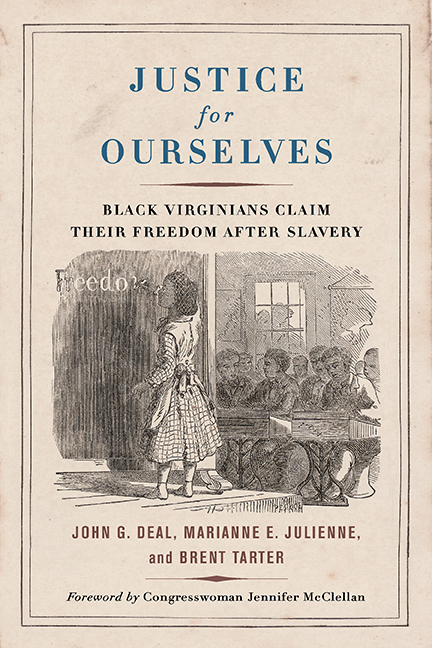
Justice for Ourselves
Black Virginians Claim Their Freedom after Slavery
John G. Deal, Marianne E. Julienne, and Brent Tarter. Foreword by Congresswoman Jennifer McClellan
Series:
awards:
Richard Slatten Award for Excellence in Virginia Biography, (2025, Winner)
A new look at the Black Virginians who defined and realized their freedom after the collapse of slavery
“Verily, the work does not end with the abolition of slavery,” wrote Frederick Douglass in 1862, “but only begins.” The Emancipation Proclamation and the Thirteenth Amendment altered a legal status; to make freedom a reality represented a different challenge altogether.
Justice for Ourselves tells the stories of remarkable Black men and women in post–Civil War Virginia who persevered in the face of overwhelming barriers to seek their freedom and create a new world for themselves and future generations. Drawing on the life stories of individuals from all regions of the state—political leaders, teachers, ministers, journalists, and entrepreneurs—Justice for Ourselves recounts their quests to attain full American citizenship and economic independence before the onset of Jim Crow repression. Centering Black voices, this book includes tales of opportunities seized and opportunities lost and will reshape the narrative of Black history and the history of Virginia in the second half of the nineteenth century.
Covers a range of topics – families, school, churches, community organizations, politics – that reflect the range of means by which African Americans sought to build or restore lives for themselves following the collapse of slavery. A valuable contribution that fills a conspicuous gap.- Daniel B. Thorp, Virginia Tech, author of In the True Blue's Wake: Slavery and Freedom among the Families of Smithfield Plantation
Skillfully weaving personal stories of Virginia’s free Black people, this work showcases the intersections of gender, racial ambiguity, ambition, and a myriad of other realities before and after Emancipation. This compelling and well-researched work challenges conventional wisdom by providing a clearer understanding of how these men and women navigated their worlds with varying degrees of success.- Christy S. Coleman, Executive Director of the Jamestown-Yorktown Foundation
- Journal of Southern HistoryThe volume successfully integrates field-defining scholarship in the historiographies of slavery and emancipation, the Civil War and Reconstruction, and the Jim Crow era—expanding our understanding of the process of emancipation and the people who fortified Black institutions in rural and urban communities throughout the state. A major strength of this study is the authors' impressive weaving together of countless life stories, drawn from the Library of Virginia's Dictionary of Virginia Biography, into a coherent narrative organized in eight thematic chapters. Individual stories animate insights alongside a robust engagement with the secondary literature on Black political life in Virginia, making this volume both a thematic study and a collective biography.
- The Journal of the Civil War EraJustice for Ourselves provides a sound analysis of how African Americans navigated the end of slavery and sought to redefine freedom in its wake. Deal, Julienne, and Tarter offer up biographies that make the events more memorable and shed light on individuals' actions. These biographies ensure that Justice for Ourselves will be especially useful for those looking to appreciate the political activism of Black Virginians and activists' unique perspectives on historicized yet not always so handsomely detailed.
This outstanding volume does more than recount obstacles Black people, regardless of status, encountered. The book reveals how Black people contested barriers and navigated a complex world . . . Deeply researched and smartly written, this is a noteworthy volume that deserves much acclaim and warrants little criticism. Those interested in a deeper understanding of the complexities of life for Black people during the Civil War era and how Black people responded to those challenges during our nation’s defining moment will find this study essential.- Emerging Civil War
John G. Deal, Marianne E. Julienne, and Brent Tarter are the editors of the Dictionary of Virginia Biography at the Library of Virginia.

