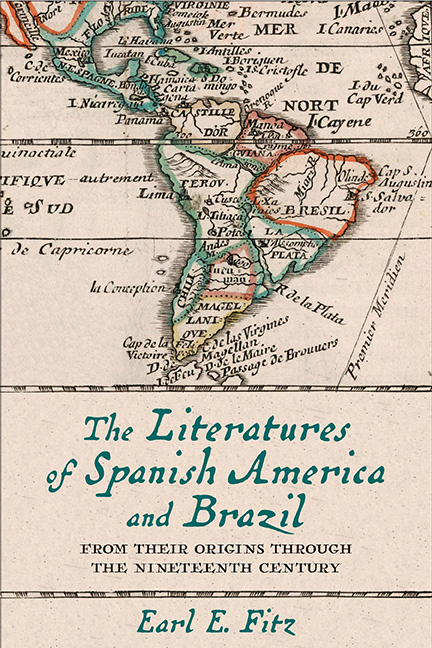
The Literatures of Spanish America and Brazil
From Their Origins through the Nineteenth Century— Volume 1
Earl E. Fitz
Series:
subjects:
In this survey of Central and South American literature, Earl E. Fitz provides the first book in English to analyze the Portuguese- and Spanish-language American canons in conjunction, uncovering valuable insights about both. Fitz works by comparisons and contrasts: the political and cultural situation at the end of the fifteenth century in Spain and Portugal; the indigenous American cultures encountered by the Spanish and Portuguese and their legacy of influence; the documented discoveries of Colón and Caminha; the colonial poetry of Mexico’s Sor Juana Inés de la Cruz and Brazil’s Gregório de Matos; culminating in a meticulous evaluation of the poetry of Nicaragua’s Rubén Darío and the prose fiction of Brazil’s Machado de Assis. Fitz, an award-winning scholar of comparative literature, contends that at the end of the nineteenth century, Latin America produced two great literary revolutions, both unique in the western hemisphere, and best understood together.
- Antonio Barrenechea, University of Mary Washington, author of America Unbound: Encyclopedic Literature and Hemispheric StudiesThis book is 'old fashioned' yet visionary. Old fashioned because it is impervious to neoliberal university trends within 2000s hemispheric studies. Cutting edge because there is something truly astonishing about Fitz's four-decade-long commitment to the humanities and to literature as a comparative and multilingual field of study. It is a major work from an inter-Americanist pioneer who has served as the single greatest custodian of Literature of the Americas in print and in the classroom.
- Luso-Brazilian ReviewThe book’s high degree of readability, its brisk pacing, minimal endnotes, and informative presentation of compelling pairings of Brazilian and Spanish American writers—many of which are expanded to include references to US and Francophone and Anglophone Canadian voices—speak to its roots in the classroom. Similarly to Terry Eagleton’s Literary Theory: An Introduction (1983), this book serves as a primer and will be equally beneficial to Latin Americanists who are eager to understand Brazil and to Brazilianists seeking to place Brazilian literature into a broader regional context. It also provides a wealth of compelling comparisons that can be expanded into seminar papers and longer research projects. I will certainly assign the book in my graduate seminars, and I suspect that many colleagues will do the same.
- HispaniaRecommended for students and professors of literature at both the upper high school and university levels. There is no doubt that this inter-American comparative approach is destined to be a fertile field of research that will contribute to enriching the dialogue between the historical, literary, and collective heritages of the American continent.
Earl E. Fitz is Professor of Portuguese, Spanish, and Comparative Literature at Vanderbilt University and the coauthor, with Elizabeth Lowe, of Translation and the Rise of Inter-American Literature.
Introduction
1. Chapter One: The Iberian Origins
2. Chapter Two: Indigenous America
3. Chapter Three: The Literature of Discovery and Conquest
4. Chapter Four: The Flowering of Latin American Letters
5. Chapter Five: The Enlightenment and Independence
6. Chapter Six: The Nineteenth Century
7. Chapter Seven: Rubén Darío, Machado de Assis, and End-of-Century Brilliance
Conclusion
Bibliography
1. Chapter One: The Iberian Origins
2. Chapter Two: Indigenous America
3. Chapter Three: The Literature of Discovery and Conquest
4. Chapter Four: The Flowering of Latin American Letters
5. Chapter Five: The Enlightenment and Independence
6. Chapter Six: The Nineteenth Century
7. Chapter Seven: Rubén Darío, Machado de Assis, and End-of-Century Brilliance
Conclusion
Bibliography

