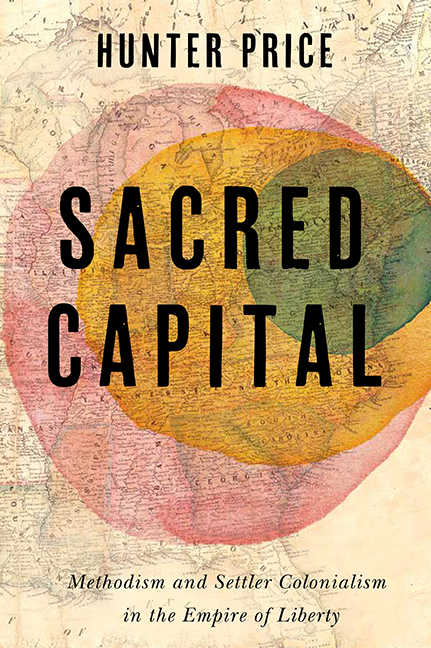
Sacred Capital
Methodism and Settler Colonialism in the Empire of Liberty
Hunter Price
Series:
subjects:
How Methodist settlers in the American West acted as agents of empire
In the early years of American independence, Methodism emerged as the new republic’s fastest growing religious movement and its largest voluntary association. Following the contours of settler expansion, the Methodist Episcopal Church also quickly became the largest denomination in the early American West. With Sacred Capital, Hunter Price resituates the Methodist Episcopal Church as a settler-colonial institution at the convergence of “the Methodist Age” and Jefferson’s “Empire of Liberty.”
Price offers a novel interpretation of the Methodist Episcopal Church as a network through which mostly white settlers exchanged news of land and jobs and facilitated financial transactions. Benefiting from Indigenous dispossession and removal policies, settlers made selective, strategic use of the sacred and the secular in their day-to-day interactions to advance themselves and their interests. By analyzing how Methodists acted as settlers while identifying as pilgrims, Price illuminates the ways that ordinary white Americans fulfilled Jefferson’s vision of an Empire of Liberty while reinforcing the inequalities at its core.
Accessibly written, with an eye for colorful details. Speaking back to the standard works on Methodism in the early republic, Price provides a more textured view of the itinerant ministry. He shows how early Methodists, seeing themselves as both pilgrims and settlers, built new settler networks across the expanding western borderlands of the United States.- Tisa Wenger, Yale University, author of Religious Freedom: The Contested History of an American Ideal
Sacred Capital provides a powerful and perceptive reframing of the story of Methodism in the early national U.S. West. Hunter Price convincingly demonstrates how Methodism’s “social principle” cut both ways. Even as it mobilized communal and familial networks to help spread the influence of a burgeoning evangelical faith to the far reaches of an expansionist settler republic, converts could use Methodism’s network to pursue their own personal, communal, and familial goals. This melding of spiritual and social uses was essential to Methodism’s success in the new republic, but it also built the tensions of that republic into the denomination itself. Price tells this story with subtlety, insight, and an eye for revealing detail, making Sacred Capital essential reading for historians of American religion and of the early republic.- Randolph Scully, George Mason University, author of Religion and the Making of Nat Turner’s Virginia: Baptist Community and Conflict, 1740-1840
Sacred Capital is well written, well researched, and contextualized. While Methodism as an agent of settler colonialism is the primary focus of the work, Price deftly weaves in several different threads, including issues of race, gender, and class, taking care not to separate the story of Methodism from other developments in the early republic, including increasing antislavery activism, and the growing sectional crisis. The author avoids myopia, while providing a thorough treatment of his topic: a difficult task, particularly in a book that maintains a manageable page count. Price makes excellent use of the existing literature to show the unique contribution his study makes to this field. His archival research especially shines. Sacred Capital expertly uses primary materials not only to piece together the skeleton of his argument but to craft compelling personal stories to demonstrate his major points....An important work for historians of the early republic, religious scholars, western historians, and those interested in the intersection of race, gender, and social class.- Journal of the Early Republic
Price gives a welcome account of the intimate connections the Methodist Episcopal Church (MEC) made that the federal government could only dream of. In doing so, Price delves into the ecclesiastical structure and hierarchy of the MEC to show how this transcontinental organizational network existed through a relay of individuals—a denominational meets social history.- Wesley and Methodist Studies
- William and Mary QuarterlyWith the publication of Sacred Capital, Hunter Price offers a fresh and important study of one of the most consequential cultural forces in the first decades of the United States: the Methodist Episcopal Church. This impressive book makes valuable contributions to the study of migration in the early American republic, the history of American religion, and especially the cultural history of American capitalism.
- Journal of Southern HistoryFilled with subtleties and insights on Methodism as understood and practiced in the new nation . . . Well written and deeply researched, it will force scholars to look at the settlement process and experience with new appreciation for religion's central role and to appreciate that for many Americans, and certainly Methodists, the spiritual and the secular were (are) never far apart.
- The Western Historical QuarterlySacred Capital is a thoughtful study, grounded in extensive manuscript research, which demonstrates how Methodism facilitated the consolidation of settler colonial society in racialized and gendered ways. It should resonate in the fields of western history and American religious history, and prompt scholars in these areas to continue their ongoing investigations into the intersections of religion and U.S. empire.
- American Historical ReviewHunter Price’s Sacred Capital: Methodism and Settler Colonialism in the Empire of Liberty is the best book on the history of early American Methodism in nearly two decades. It offers a fresh reading of welltrod sources and new insights into the histories of religion, social networks, and westward expansion in the nineteenth-century United States. Methodism, Price convincingly shows, was a key player in the settler colonialism that expanded North America’s western frontier.
- The Journal of American HistorySacred Capital gives us a fresh approach to the history of religion and western migration. Both its methods and its view of religion and material culture make this a commendable book.
- Register of the Kentucky Historical SocietyAs the United States grapples with colonization's legacy, Price's accessible monograph is a must-read for anyone interested in the history of religion or the American West.
Hunter Price is Associate Professor of History at Western Washington University.

