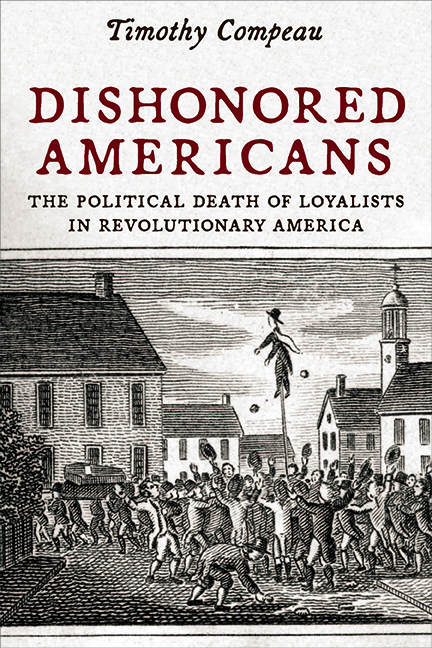
Dishonored Americans
The Political Death of Loyalists in Revolutionary America
Timothy Compeau
Series:
subjects:
With the final words of the Declaration of Independence, the signatories famously pledged to one another their lives, their fortunes, and their "sacred Honor." But what about those who made the opposite choice? By looking through the analytical lens of honor culture, Dishonored Americans offers an innovative assessment of the experience of Americans who made the fateful decision to remain loyal to the British Crown during and after the Revolution.
Loyalists, as Timothy Compeau explains, suffered a "political death" at the hands of American Patriots. A term drawn from eighteenth-century sources, ‘political death’ encompassed the legal punishments and ritualized dishonors Patriots used to defeat Loyalist public figures and discredit their counter-revolutionary vision for America. By highlighting this dynamic, Compeau makes a significant intervention in the long-standing debate over the social and cultural factors that motivated colonial Americans to choose sides in the conflict, narrating in compelling detail the severe consequences for once-respected gentlemen who were stripped of their rights, privileges, and power in Revolutionary America.
- Rebecca Brannon, James Madison University, author of From Revolution to Reunion: The Reintegration of the South Carolina LoyalistsAn amazingly well-written book that is calculated to appeal to a wide audience while making an important and timely intervention in both the study of honor and Loyalist history. The argument is perceptive and convincing: that what united ordinary white Loyalists with elite Loyalists was the visceral sense of disrespect deliberately perpetuated by Patriots in their campaign.
- Brad Jones, California State University, Fresno, author of Resisting Independence: Popular Loyalism in the Revolutionary British AtlanticDishonored Americans offers an entirely new and innovative approach to understanding Loyalism during the American Revolution. Well written and deeply researched, Timothy Compeau draws readers into a world largely forgotten today, where a deeply entrenched culture of honor – and dishonor – in colonial society shaped wartime political allegiances, and ultimately helped Loyalist exiles navigate their post-war Empire.
[Compeau's] argument about the process of 'political death' and 'political rebirth'—essentially the unmanning and reclaiming of Loyalist masculinity—adds a compelling angle to scholarly understanding not only of Loyalists as individuals, but also of elite masculinity and power relationships in the Revolutionary era. Compeau convincingly shows that 'whereas political death was a product of revolutionary fervor, political rebirth emerged from the routine functions of honor culture that maintained social harmony and elite control' (171).- H-Early-America
Compeau convincingly demonstrates that honor culture regulated behavior and reflected the operation of power. . . Historians of identity and allegiance in the Revolutionary Atlantic will find Compeau’s honor framework full of insights into the mechanics of politics in the era.- Journal of Southern History
An important book. Compeau’s persuasive argument about the centrality of honor culture to the experiences of Loyalists makes it a work of relevance to historians of loyalism and the Revolutionary era more generally.- Journal of the Early Republic
The strength of this work is its attribution of humanity, reasonings, and voice—even through a confusing set of now antiquated honor practices—to Loyalists previously glossed over in the American popular version of the war’s causes, events, and outcomes. . . . [C]ontributes nicely to the historiographical treatment of a complicated time and war.- North Carolina Historical Review
- Register of the Kentucky Historical SocietyA solid and innovative contribution to the literature on American loyalism, which is becoming more and more sophisticated and penetrating. Compeau’s application of honor culture, a category of analysis that has usually applied to explain 1790s politicians or 1850s Southern planters, makes this book stand out from others and deserves attention from historians of the Revolution.
- H-WarTimothy Compeau’s book, Dishonored Americans: The Political Death of Loyalists in Revolutionary America, joins a robust body of scholarship and makes an important interjection in the field through the introduction of the political death of Loyalists.
Timothy Compeau is Assistant Professor of History at Huron University College at the University of Western Ontario.

