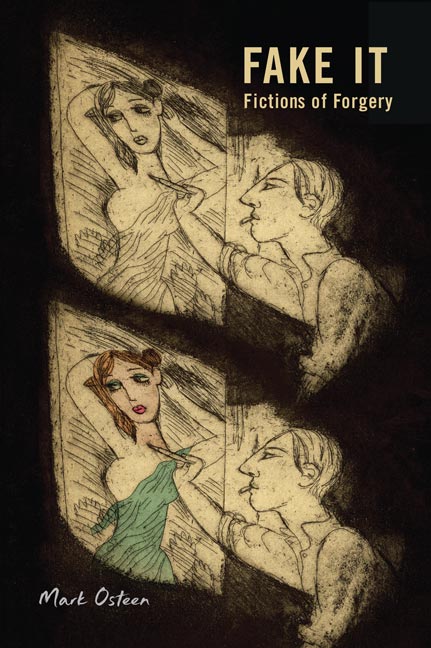
Fake It
Fictions of Forgery
Mark Osteen
subjects:
How many layers of artifice can one artwork contain? How does forgery unsettle our notions of originality and creativity? Looking at both the literary and art worlds, Fake It investigates a set of fictional forgeries and hoaxes alongside their real-life inspirations and parallels. Mark Osteen shows how any forgery or hoax is only as good as its authenticating story—and demonstrates how forgeries foster fresh authorial identities while being deeply intertextual and frequently quite original.
From fakes of the late eighteenth century, such as Thomas Chatterton’s Rowley poems and the notorious "Shakespearean" documents fabricated by William-Henry Ireland, to hoaxes of the modern period, such as Clifford Irving’s fake autobiography of Howard Hughes, the infamous Ern Malley forgeries, and the audacious authorial masquerades of Percival Everett, Osteen lays bare provocative truths about the conflicts between aesthetic and economic value. In doing so he illuminates the process of artistic creation, which emerges as collaborative and imitative rather than individual and inspired, revealing that authorship is, to some degree, always forged.
- Margaret Russett, University of Southern California, author of Fictions and Fakes: Forging Romantic Authenticity, 1760–1845Lively, accessible, perceptive, witty, informative, and entertaining. Osteen’s research and scholarship are impeccable. The book offers an excellent gloss on postmodernist pastiche through the lens of ‘forgery fictions’—stories about forgery that often verge on, or cross entirely over to, the status of forgeries themselves.
- Paul K. Saint-Amour, University of PennsylvaniaWith Fake It, Mark Osteen marches up to the church of forgery and nails his 15 theses to the door. Who knew there were still so many pieties about literary forgery to unsettle? Fake It is our most comprehensive, clear-eyed, and provocative account yet of imposture’s relation to narrative and fictionality.
The close readings are consistently insightful and rewarding, and the prose manages to be both accessible and formally experimental at the same time. Fake It is engaging and stimulating. **Recommended.- Choice
Mark Osteen, Professor of English and Director of the Center for the Humanities at Loyola University Maryland, is author of Nightmare Alley: Film Noir and the American Dream.
Acknowledgments
Prologue: Genuine Articles
1. Thomas Chatterton’s Ghosts
2. "What King Forged I?": Fathers, Frauds, and the Works of William Fakespeare
3. Hideous Progeny: Forgery, Frankenstein, and Peter Carey’s My Life as a Fake
4. Fuck It: Percival Everett’s Fake Book
5. Original Sins: Painting the Perfect Fake in The Recognitions
6. But Is It Art?: Orson Welles’s Cubist Portrait of the Forger in F for Fake
7. Misrecognizing Harry: The Blazing World’s Hermaphroditic Polyphony
Epilogue
Notes
Works Cited
Index
Prologue: Genuine Articles
1. Thomas Chatterton’s Ghosts
2. "What King Forged I?": Fathers, Frauds, and the Works of William Fakespeare
3. Hideous Progeny: Forgery, Frankenstein, and Peter Carey’s My Life as a Fake
4. Fuck It: Percival Everett’s Fake Book
5. Original Sins: Painting the Perfect Fake in The Recognitions
6. But Is It Art?: Orson Welles’s Cubist Portrait of the Forger in F for Fake
7. Misrecognizing Harry: The Blazing World’s Hermaphroditic Polyphony
Epilogue
Notes
Works Cited
Index

