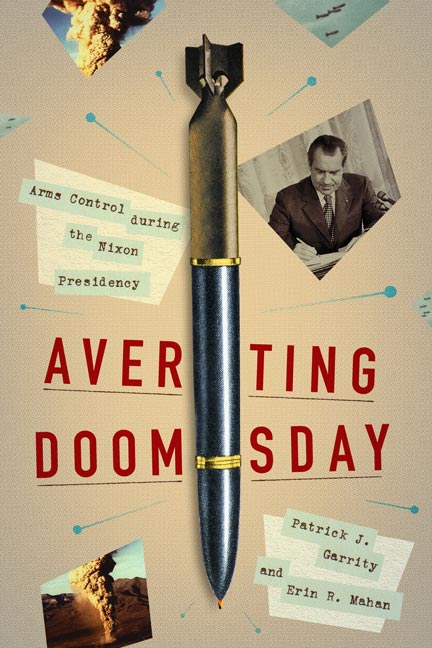
Averting Doomsday
Arms Control during the Nixon Presidency
Patrick J. Garrity and Erin R. Mahan
In the controversial legacy of the Nixon presidency, the administration’s effort to curb and control the spread of the world’s weapons of mass destruction is often overlooked. And yet by the time President Nixon left office under the cloud of the Watergate scandal, his actions on this front had surpassed those of all his predecessors combined and laid the foundations of WMD arms control and nonproliferation policies that persist to this day.
In Averting Doomsday, Patrick Garrity and Erin Mahan explore and assess Nixon’s record, addressing not only nuclear but also biological and chemical weapons. Drawing substantially on presidential recordings and other primary sources not widely consulted, the authors shed new light on milestones such as the first SALT agreement on strategic nuclear weapons and the Anti-Ballistic Missile Treaty, as well as the renunciation of US offensive biological weapons and a Seabed treaty. The WMD-control landscape had accumulated many divergent visions and interests over time—technical, diplomatic, domestic political, and utopian. The Nixon administration had to adjust to and build on this eclectic foundation, creating a new layer of policies to deal with WMD that substantially set the course—and perhaps limited the options—for future administrations in ways that are still with us.
Miller Center Studies on the Presidency
- Thomas A. Schwartz, Vanderbilt University, author of Henry Kissinger and American Power: A Political BiographyEminently readable and surprisingly fast-paced. One of the best case studies I have read on the significance of bureaucratic politics for international negotiation.
- Hal Brands, Johns Hopkins UniversityThis book offers a comprehensive appraisal of arms control during a critical era. It deftly illuminates the competing perspectives that shaped America's policy on an issue—how to handle weapons of mass destruction—that continues to preoccupy the national security community today.
- Shannon Bugos · Arms Control TodayDrawing on an extensive collection of presidential recordings and documents not widely consulted, the authors bring together all aspects of the Nixon administration’s efforts "to combat germs, gases, and the bomb" and puts forward a context for better understanding the national securitypolicies pursued by the president and his advisors.
Patrick J. Garrity is Nonresident Senior Fellow at the Miller Center of Public Affairs and author of In Search of Monsters to Destroy? American Foreign Policy, Revolution, and Regime Change, 1776–1900. Erin R. Mahan is Chief Historian at the Office of the Secretary of Defense and author of Kennedy, De Gaulle, and Western Europe.
Preface
1. Nixon's Arms Control Inheritance
2. National Security Landscape and Arms Control Agenda
3. Two Paths: Biological and Chemical Weapons Control
4. Nixon's Crown Jewel of Arms Control: SALT and ABM
5. Nuclear Nonproliferation and a Strategy of Ambivalence
6. Unfinished Business of SALT II
7. Reconciling Nuclear Testing with Arms Control
8.Legacies and Implications
List of Common Abbreviations
Notes
Bibliography
Index
1. Nixon's Arms Control Inheritance
2. National Security Landscape and Arms Control Agenda
3. Two Paths: Biological and Chemical Weapons Control
4. Nixon's Crown Jewel of Arms Control: SALT and ABM
5. Nuclear Nonproliferation and a Strategy of Ambivalence
6. Unfinished Business of SALT II
7. Reconciling Nuclear Testing with Arms Control
8.Legacies and Implications
List of Common Abbreviations
Notes
Bibliography
Index

