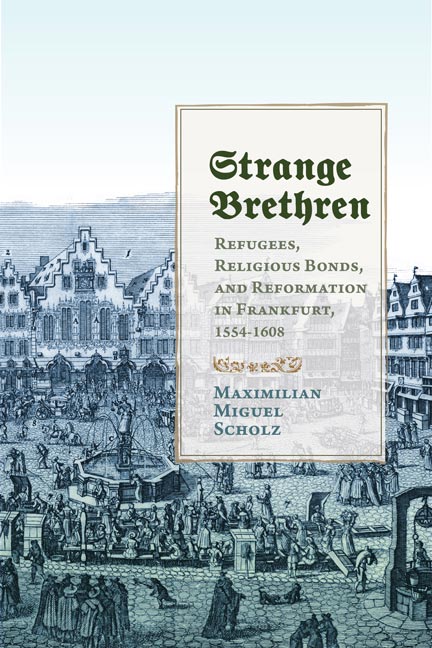
Strange Brethren
Refugees, Religious Bonds, and Reformation in Frankfurt, 1554–1608
Maximilian Miguel Scholz
subjects:
In the sixteenth century, German cities and territories welcomed thousands of refugees fleeing the religious persecution sparked by the Reformation. As Strange Brethren reveals, these Reformation refugees had a profound impact on the societies they entered. Exploring one major destination for refugees—the city of Frankfurt am Main—Maximilian Miguel Scholz finds that these forced migrants inspired new religious bonds, new religious animosities, and new religious institutions, playing a critical role in the course of the Reformation in Frankfurt and beyond.
Strange Brethren traces the first half century of refugee life in Frankfurt, beginning in 1554 when the city granted twenty-four families of foreign Protestants housing, workspace, and their own church. Soon thousands more refugees arrived. While the city’s ruling oligarchs were happy to support these foreigners, the city’s clergy resented and feared the refugees. A religious fissure emerged, and Frankfurt’s Protestants divided into two competing camps—Lutheran natives and Reformed (Calvinist) foreigners. Both groups began to rethink and reinforce their religious institutions. The religious and civic impact was substantial and enduring. As Strange Brethren shows, many of the hallmarks of modern Protestantism—its confessional divides and its disciplinary structures—resulted from the encounter between refugees and their hosts.
Studies in Early Modern German History
- Joel F. Harrington, Vanderbilt UniversityA fascinating in-depth examination of a key chapter in post-Reformation history. Scholz's meticulous description and analysis of the evolving relations between Frankfurt's Reformed refugees and their Lutheran hosts have significant implications for many larger questions about the nature of confessional coexistence and conflict during this pivotal period.
- Jesse Spohnholz, Washington State University, author of Ruptured Lives: Refugee Crises in Historical PerspectiveMaximilian Miguel Scholz takes his readers into a strange and yet familiar world in which hosts and refugees negotiated difficult relationships shaped by religious differences, economic insecurities, and political pressures. Informed by his deep dive into the sources, Scholz offers a sympathetic and critical look into the lives of sixteenth-century German hosts and the French-, Dutch-, and English-speaking forced migrants who sought sanctuary in their city. Strange Brethren not only provides important contributions to scholarship on early modern European history but also offers critical historical perspective for debates today.
Maximilian Miguel Scholz is Assistant Professor of History at Florida State University.
Acknowledgments
Notes on Names and Terminology
Introduction
1. New Dangers, New Allies, and the Emergence ofRefugee Accommodation in Frankfurt
2. Refugee Arrivals and the Advent of Confessionalism
3. Refugee Controversies and the End of Accommodation
4. The Quest for Legal Protection Outside of Frankfurt
5. Preserving Reformed Life in Frankfurt
Conclusion: The Transformative Power ofRefugee Accommodation
Epilogue: Goethe’s Tutor
Notes
Bibliography
Index
Notes on Names and Terminology
Introduction
1. New Dangers, New Allies, and the Emergence ofRefugee Accommodation in Frankfurt
2. Refugee Arrivals and the Advent of Confessionalism
3. Refugee Controversies and the End of Accommodation
4. The Quest for Legal Protection Outside of Frankfurt
5. Preserving Reformed Life in Frankfurt
Conclusion: The Transformative Power ofRefugee Accommodation
Epilogue: Goethe’s Tutor
Notes
Bibliography
Index

