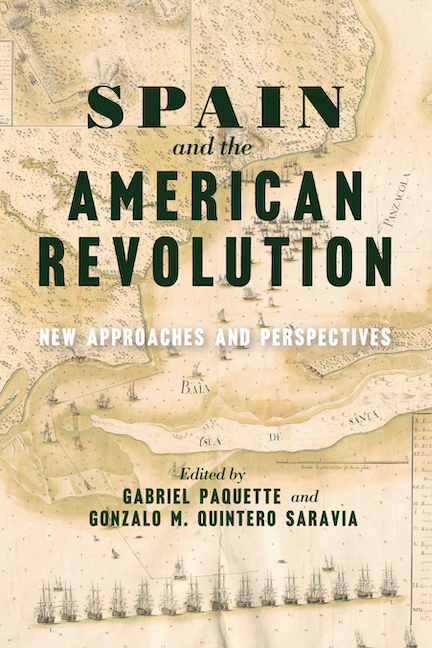
Spain and the American Revolution
New Approaches and Perspectives
Edited by Gabriel Paquette and Gonzalo M. Quintero Saravia
Series:
subjects:
Although the participation of France in the American Revolution is well established in the historiography, the role of Spain, France’s ally, is relatively understudied and underappreciated. Spain’s involvement in the conflict formed part of a global struggle between empires and directly influenced the outcome of the clash between Britain and its North American colonists. Following the establishment of American independence, the Spanish empire became one of the nascent republic’s most significant neighbors and, often illicitly, trading partners. Bringing together essays from a range of well-regarded historians, this volume contributes significantly to the international history of the Age of Atlantic Revolutions.
Contributors:Eric Becerra, University of North Carolina * Larrie D. Ferreiro, George Mason University * Gregg French, University of Windsor * Mary-Jo Kline, independent scholar * Manuel Lucena Giraldo, International University in Spain * Benjamin C. Lyons, University of Utah * Anthony McFarlane, University of Warwick * Ross Michael Nedervelt, Florida International University * John W. Nelson, Texas Tech University * Emmanuelle Perez Tisserant, University of Toulouse * Eduardo Posada Carbó, University of Oxford * Emily Berquist Soule, California State University, Long Beach * María Bárbara Zepeda Cortés, Lehigh University
- Hispanic American Historical ReviewA mosaic that adds several new insights.
- Kenneth J. Andrien, Southern Methodist UniversityThis well-crafted collection of essays promises to refocus scholarly attention on the crucial monetary and military assistance that Spain provided the revolutionaries in the War of the American Revolution. This book will undoubtedly stimulate further research on this important topic, and the volume will be of interest to students and specialists of Latin American, early U.S., and Atlantic World history.
Throughout this volume, the authors reclaim Spain’s rightful place in the centrality of the American Revolution. As historiography moves into a more Atlantic context, Spain deserves more attention in the historical analysis . . . The chapters incorporated in this volume will be invaluable for any student of the American Revolution, Spanish-American borderlands, or the Atlantic world in the Age of Revolutions.- Colin Mathison (University of Mississippi) · H-Early-America
Gabriel Paquette is Professor of History and International Studies at the University of Oregon and author of The European Seaborne Empires: From the Thirty Years’ War to the Age of Revolutions. Gonzalo M. Quintero Saravia, a senior Spanish diplomat, is author of Bernardo de Gálvez: Spanish Hero of the American Revolution, winner of the Society for Military History’s Best Book Prize.
List of Illustrations
Acknowledgements
Contributor Biographies
1. Introduction: Spain and the American Revolution
2. The American Revolution and Spanish America, 1776-1814
3. The Rise and Fall of the Spanish-French Bourbon Armada, from Toulon to Pensacola to Trafalgar
4. Jose's Secrets: Minister Galvez's Master Plan for Spain's Participation in the American Revolution
5. "Forseeing What Great Occasions Might Come": American independence and Spanish naval reformers
6. The Spanish Slave Trade During the American Revolutionary War
7. Spain's Bid for the American Interior?: The Imperial Contest over the Revolutionary Great Lakes
8. Spain and the American Revolution: A Pacific Perspective
9. Law in Early-Modern Diplomacy: The Jay-Floridablanca Negotiations of 1780
10. Sarah Livingston Jay (1756-1802): A Republican Lady in Spain
11. Securing the Borderlands/Seas in the American Revolution: Spanish-American Cooperation and Regional Security Against the British Empire
12. Spain and the Birth of the American Republic: Establishing Lasting Bonds of Kinship in the Revolutionary Era
13. A New Guardian: The Values of the American Revolution in Post-Revolutionary Spanish Louisiana Settlements
14. Spanish America and US Constitutionalism in the Age of Revolution
Bibliography
Index
Acknowledgements
Contributor Biographies
1. Introduction: Spain and the American Revolution
2. The American Revolution and Spanish America, 1776-1814
3. The Rise and Fall of the Spanish-French Bourbon Armada, from Toulon to Pensacola to Trafalgar
4. Jose's Secrets: Minister Galvez's Master Plan for Spain's Participation in the American Revolution
5. "Forseeing What Great Occasions Might Come": American independence and Spanish naval reformers
6. The Spanish Slave Trade During the American Revolutionary War
7. Spain's Bid for the American Interior?: The Imperial Contest over the Revolutionary Great Lakes
8. Spain and the American Revolution: A Pacific Perspective
9. Law in Early-Modern Diplomacy: The Jay-Floridablanca Negotiations of 1780
10. Sarah Livingston Jay (1756-1802): A Republican Lady in Spain
11. Securing the Borderlands/Seas in the American Revolution: Spanish-American Cooperation and Regional Security Against the British Empire
12. Spain and the Birth of the American Republic: Establishing Lasting Bonds of Kinship in the Revolutionary Era
13. A New Guardian: The Values of the American Revolution in Post-Revolutionary Spanish Louisiana Settlements
14. Spanish America and US Constitutionalism in the Age of Revolution
Bibliography
Index

